
What Is Entropy?
Entropy is the degree of randomness, disorder, or chaos within a system. As entropy increases, temperature increases, because the components of the system are moving more rapidly and releasing wasted energy. Wasting energy in that manner decreases the capacity of the components to do work*.
*Work is to be defined as the capacity of the components to communicate adequately, or transfer energy from one component to another. All energy transfers are forms of communication between individuals.
Example:
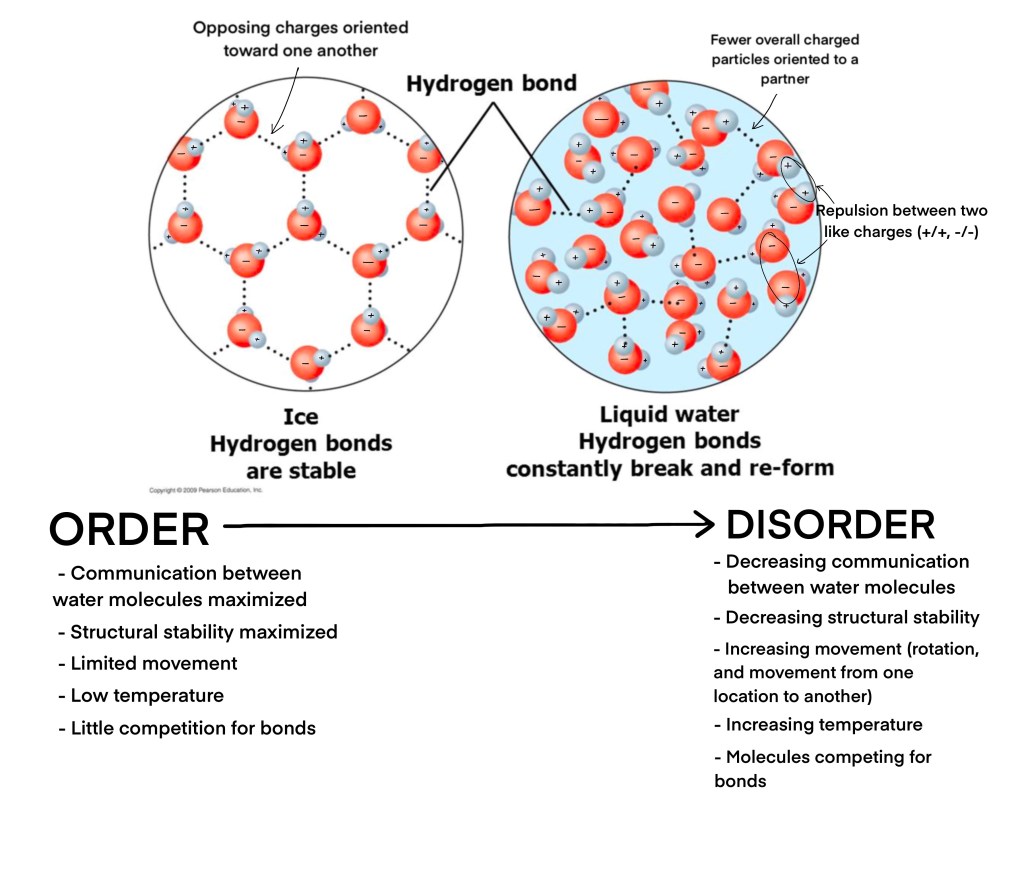
- Boiling water is hot, because the water molecules are moving more quickly against one another within a confined space. On the opposite end, ice is cold, because the water molecules are more organized, or less randomly positioned.
Let us unpack this example:
As ice melts, the bonds between the individual components are broken. The water molecules are forced apart, preventing them from forming a cohesive structure. However, the water molecules are still attracted to one another by charge polarity (positive charges are attracted to negative charges and vice versa, exactly like magnets).
Increasing entropy, then, involves two factors:
1. Speed: With increasing speed, the length of time each individual component is allowed to communicate with the others decreases. This prevents them from communicating long enough to form a stable bond.
2. Orientation / Rotation: The individuals within a confined space lose control over their orientation, or direction of movement. Two like charges (+/+ and -/-) repel one another, causing the molecules to spin.
Entropy/disorder increases competition for bonds and increases disruption of communication by causing the individuals to knock into other individuals, forcing other individuals to rotate away from their partner, or both.

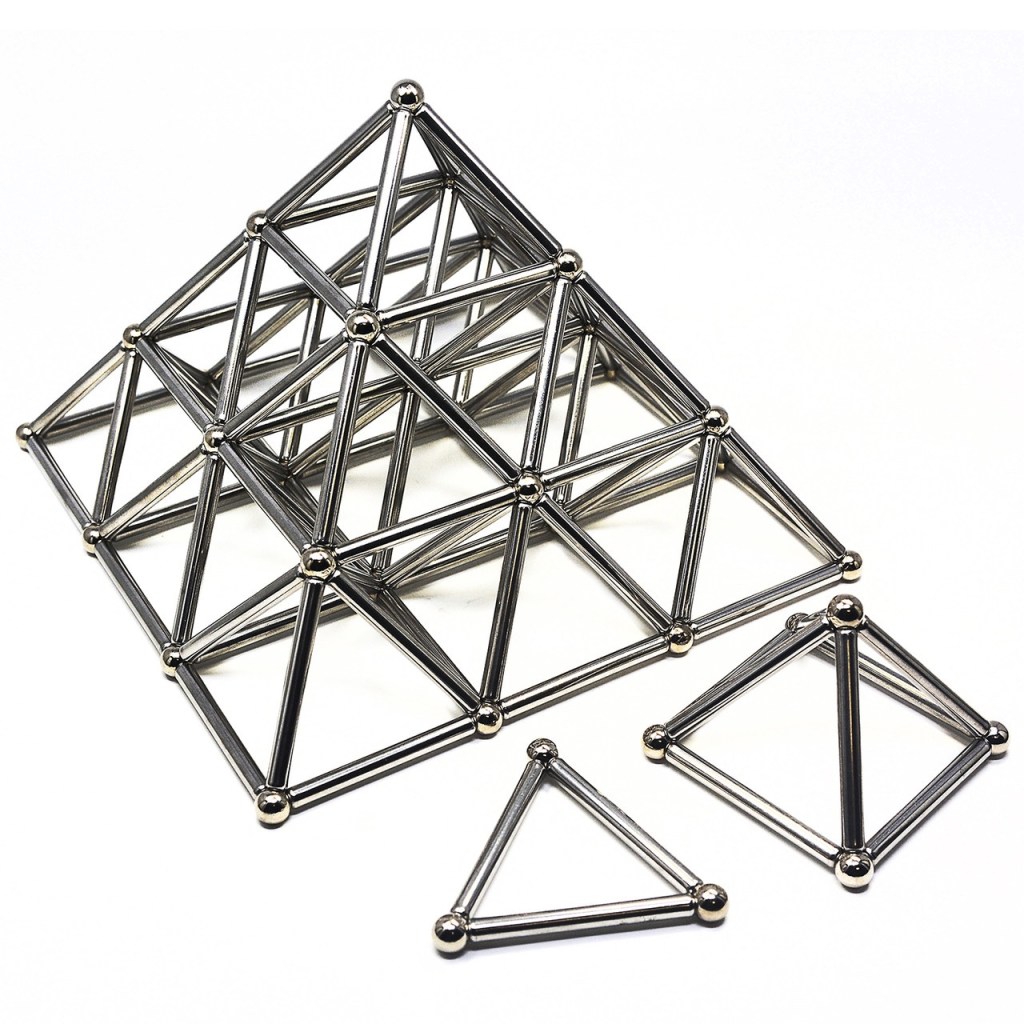
In other words, you cannot simply throw magnets around randomly, at rapid speeds, and expect them to form any kind of structure. It would be like throwing a bunch of magnets into the air and expecting them to form a structure like this:
This begs the question: How on Earth did evolution take us from a soup of single-celled organisms to large, well-organized, structures, over and over again? You are a structure made of trillions of individual components, all of which are perfectly organized and capable of holding their shape, yet flexible enough to self-heal.
Refer to the magnetic structure again: How likely is that structure to build itself? The answer is: Almost impossible, which is why people turn to religious beliefs that include an external intelligent designer (God). However, life on this planet is profoundly special, because it is building itself, based upon this template:

Up Next: We will explore trends in reproduction and gender in Nature.
 The Rainbow Connection