
Preface/Trigger Warning: Gender is an incredibly volatile subject, so please bear with me. I believe gender to be a volatile subject, because our gender dynamics are changing in a manner that we have yet to understand. The gender binary is a very real and natural phenomenon, AND not following a gender binary is also a very real and natural phenomenon.
The Binary Breakdown:
I simplify the binary into three parties, based upon metabolism:
1. Female: Chloroplast/Plant
2. Male: Mitochondria/Fungi
3. Everything else in between, resulting from a combination between the two above players. Animal cells seem to have both photosynthetic and fungal ancestry, but to varying degrees. A cell of fungal ancestry would have attempted to break through a cell of photosynthetic ancestry, activating a defense response that ultimately resulted in the two parties fusing together temporarily, the product having a combination of traits of both original parties. How “feminine” or “masculine” a species is becomes entirely dependent upon metabolism and how the species responds to light:
The feminine absorbs light to create potential energy in the form of bonds using chlorophyll or Vitamin D production (this creates order and a decrease in temperature), while the mitochondria releases light to disperse potential energy by breaking the bonds made by the light absorption (this creates disorder and an increase in temperature). The two parties work together to maintain structural integrity and flexibility, respectively. For a refresher on order/entropy, please refer to Philosophy of Entropy in the drop down menu.
Proposed Mechanism:
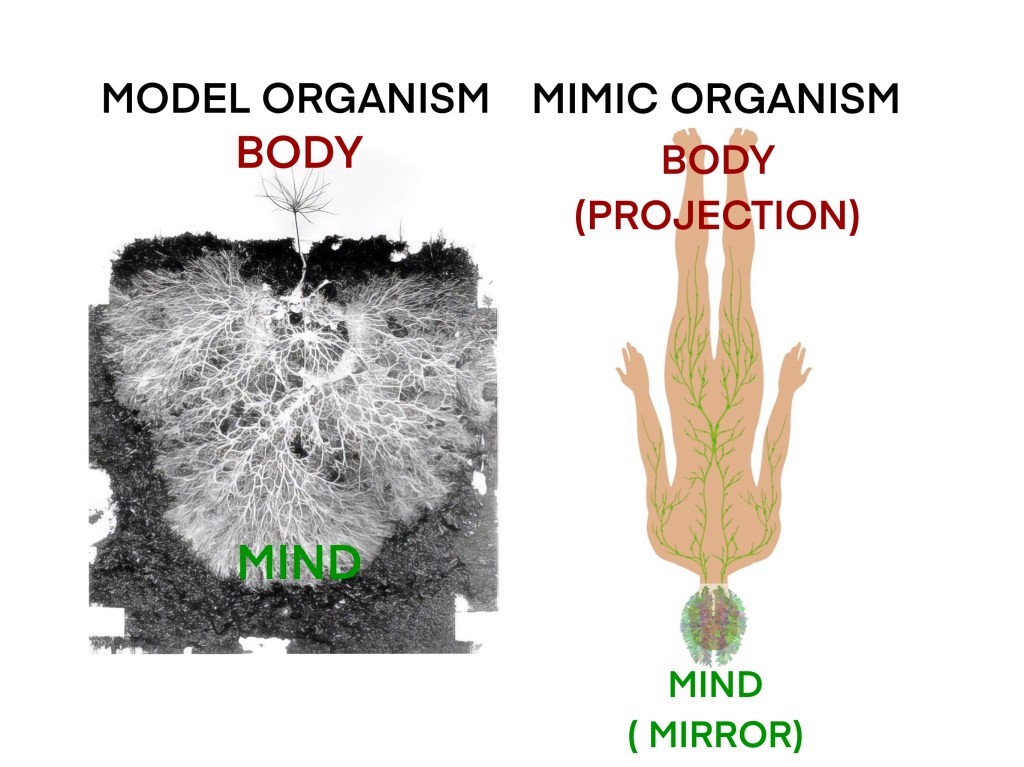
The first vertebrates were resultant of a process in which a fungal cell fertilized a tree from the inside out, yielding a seed coated in excess calcium. The excess calcium would have prevented the seed from fully embedding into the soil, resulting in the first brain. The excess calcium allowed the new organism to be mobile by providing a source of portable excess calcium storage that can be used for movement when broken down. However, these organisms lost the capacity to photosynthesize as a result, making them reliant on an analog, Vitamin D.
Updating the Endosymbiotic Theory:
The Endosymbiotic Theory is a proven hypothesis regarding how eukaryotic cells obtained mitochondria for metabolism. Below is our current understanding of Endosymbiotic Theory:
This updated ideology does not disprove this theory, but simply adds detail. The two parties involved would have been inside of photosynthetic and fungal ancestral cells:
- The mitochondria would not have entered on its own. Instead, it would have been inside of an ancestral fungal cell.
- The fungal ancestral cell would have been attempting to digest the ancestral photosynthetic cell, making this interaction a predator-prey dynamic.
- Instead of the predation attempt being successful, the ancestral photosynthetic organism initiated an immune response, and started to engulf the ancestral fungal cell.
- Instead of digesting the ancestral fungal cell in its entirety, the ancestral photosynthetic organism would have fused with it in order to obtain the benefits of having mitochondria for metabolism. In return, the fungal progenitor increased in its integrity and capacity for light absorption, increasing its chances of survival.
- This interaction would have occurred to differing degrees of success, later culminating into sexual reproduction and the many differing reproductive strategies seen within the animal kingdom. This is the basis for how mating rituals and the gestation process can be understood, and establishes a metabolic point of interconnectivity between all living things.
 The Rainbow Connection